Strange Folklore: The Valley of Headless Men
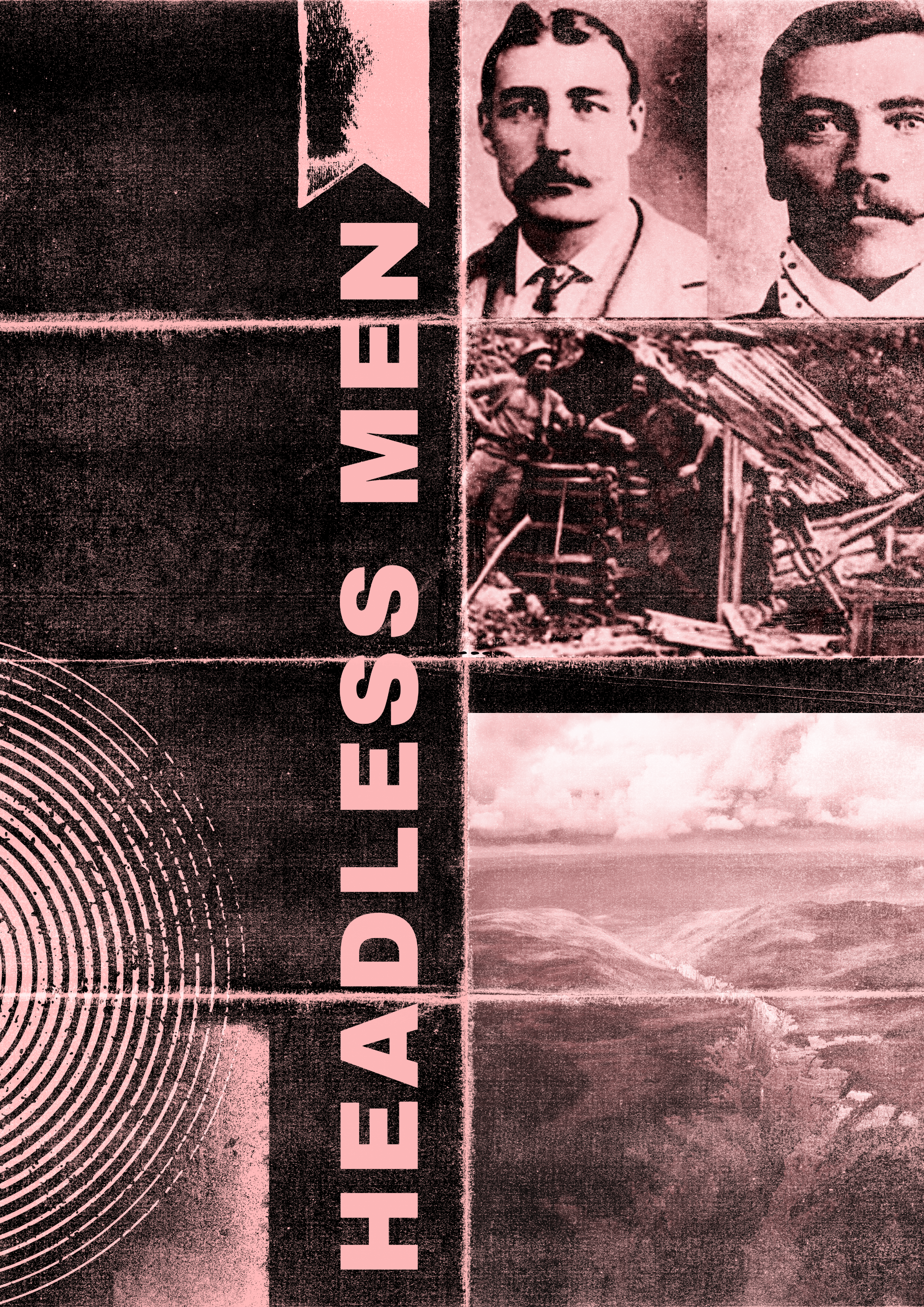
Two brothers went into the Nahanni Valley looking for gold.
They didn’t come back.
When searchers finally found William and Frank McLeod near the South Nahanni River, both men were dead. Both were missing their heads. Their third companion had vanished, too.
This is where one of Canada’s strangest wilderness legends begins — a mix of dark history, folklore, lost gold, and real unsolved deaths
The place is usually called the Valley of the Headless Men, Headless Valley, or Deadmen Valley. The real location belongs to the South Nahanni River country in Canada’s Northwest Territories, a remote region of canyons, mountains, hot springs, caves, waterfalls, and brutal backcountry travel.
Today, much of that landscape falls within Nahanni National Park Reserve, a UNESCO World Heritage Site. But before the park designation, before the documentaries, before the wilderness tourism, the Nahanni pulled in prospectors chasing gold.
Some of them never made it back out.
Where Is the Nahanni Valley?
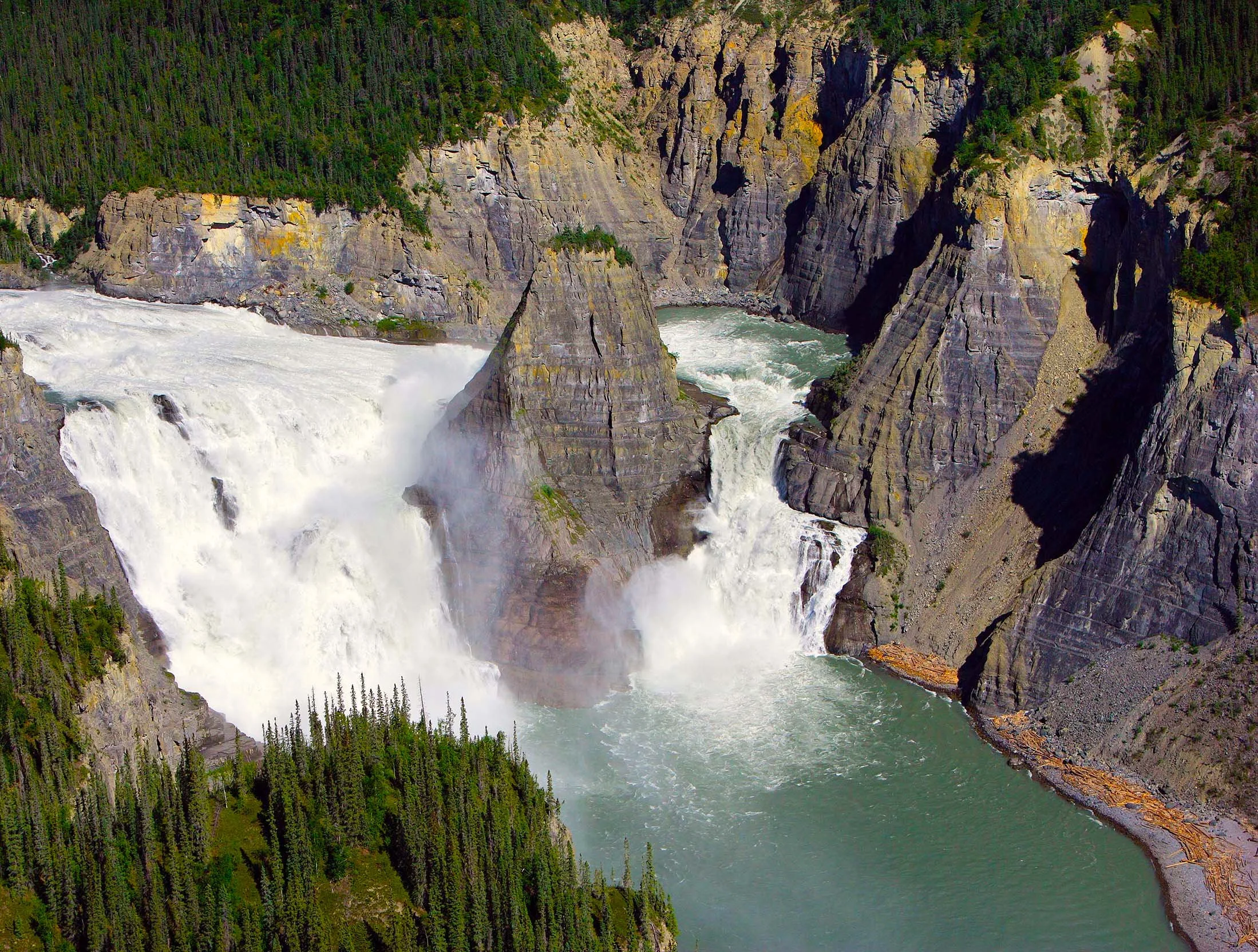
The South Nahanni River runs through the Mackenzie Mountains in the southwestern Northwest Territories, near the Yukon and British Columbia borders. Parks Canada uses the Dene name Nahą Dehé for the South Nahanni River, and the park reserve overlaps with the asserted territories and traditional lands of several Indigenous communities, including Dehcho Dene and Métis, Nahą Dehé Dene, Sahtu Dene and Métis, Kaska Dena, and Acho Dene Koe First Nation.
The landscape is stunning, but it isn’t gentle. The river cuts through deep canyons. The country includes karst terrain, caves, alpine tundra, forests, hot springs, and major waterfalls. A trip there in the early 1900s meant travel by river, portage, and foot with months of supplies.
A broken canoe could end the trip. A missed food cache could turn dangerous fast. A badly timed season could trap a party behind ice. A fall, infection, injury, or sudden weather shift could kill a man far from help.
The promise of gold made men take the chance anyway.
The Legends Before the Prospectors
Long before southern newspapers gave the Nahanni its haunted reputation, Dene communities knew the wider region through travel, hunting, and oral tradition.
Later written versions of Nahanni folklore describe the valley as dangerous country. These tales include strange cries in the canyons, beings living in the mountains, stories of the Naha people, and legends tied to a hidden warm valley somewhere in the watershed.
Modern writers added even more to the lore: the White Queen, the waheela, the nuk-luk, and missing hunters.
Some of that belongs to Indigenous oral tradition. Some comes from settler-era wilderness writing. Some comes from newspaper exaggeration, travel books, and campfire retellings.
This mix of Indigenous oral tradition, settler folklore, and documented violence is what turned the Nahanni Valley into one of Canada’s most searched dark history stories.
Gold Fever Reaches the Nahanni
By the early 1900s, rumors of gold in the South Nahanni country had already started pulling prospectors into the region.
That timing wasn’t random. The Klondike Gold Rush had made northern gold feel possible to thousands of men. Even after the biggest rush faded, rumors still carried power. A man didn’t need proof of a rich strike. Sometimes he only needed a few coarse flakes, a good story from another prospector, or a rumor that somebody had found pay dirt in a creek nobody else could locate.
That kind of hope could ruin a man’s life. It could also send him deep into rough backcountry, where one wrong decision could kill him.
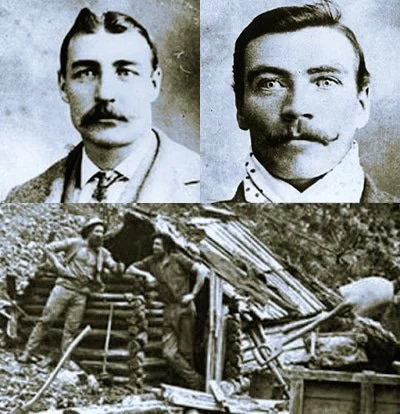
William McLeod had already been into the Nahanni before. According to later accounts, he came back with enough coarse gold to convince others that the region might be worth another trip.
In 1905, William and his brother Frank headed back toward the South Nahanni. A third man, Robert Weir, went with them.
Then winter closed in.
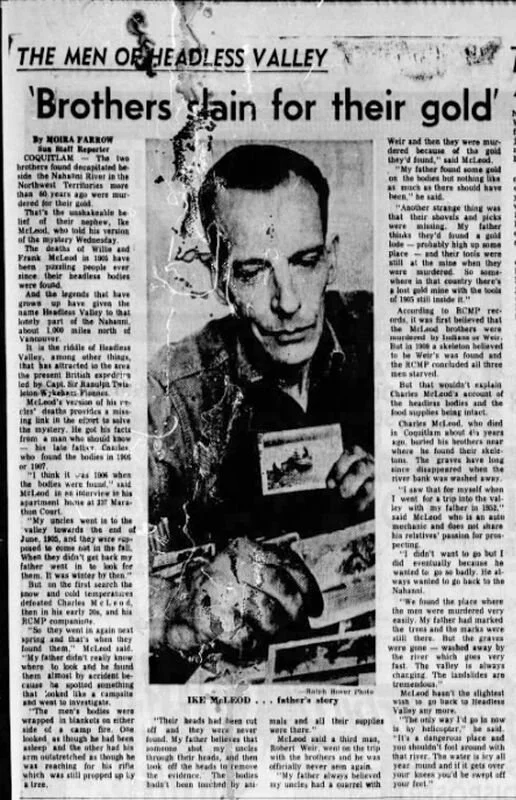
The men missed their expected return window. The river froze. Searchers couldn’t move in until the next season.
When another McLeod brother, Charlie, finally joined the search in 1906, he knew enough about William and Frank’s route to follow their likely path into the valley. The search party worked through camps and travel points until they reached a place near what later became Deadmen Valley.
There, near the river, they found William and Frank McLeod.
The brothers were dead beside each other.
Both were missing their heads.
Robert Weir wasn’t with them. Searchers didn’t find him nearby. He disappeared from the same expedition and was never confirmed alive afterward.
Did Weir die somewhere else? Did someone kill all three men? Did Weir kill the brothers and vanish with gold? Rumors later claimed he had turned up as far away as Vancouver, but those claims were never proved.
The McLeod deaths gave the region several of its most infamous place names. Deadmen Valley. Headless Creek. Headless Range. Headless Valley.
That is how the Valley of the Headless Men entered Canadian dark history.
Martin Jorgensen and the Burned Cabin
The McLeod brothers weren’t the last men tied to the legend.
In 1917, a prospector named Martin Jorgensen went into the Nahanni region looking for gold. He built a cabin near the Flat River area and reportedly sent word that he had found a promising strike.
Then he stopped communicating.
When searchers later reached his camp, they found his cabin burned. They found Jorgensen’s remains nearby. His head was missing.
That discovery deepened the legend pretty fast. A prospector had gone into remote gold country. He had reportedly found gold. His cabin burned. His body was found without a head.
The McLeod case could have been a single act of violence. Jorgensen’s death gave the legend another headless prospector, another remote camp, and another unanswered question
More Deaths and Disappearances
In 1928, searchers found the bones of a prospector called “Yukon” Fisher near a creek. The surviving details are thin, which makes his death harder to sort into murder, accident, exposure, animal activity, or backcountry misfortune.
Three trappers also disappeared in the wider valley area. Their case carries fewer details than the McLeod and Jorgensen deaths. All we really know is that hey went into the backcountry and didn’t return.
In 1945, an Ontario miner named Ernest Savard died in the Nahanni. Woodsman Walter J. Tully later found him dead in his sleeping bag. His head was described as nearly severed.
Again, a horrific detail that makes the death sound violent. At the same time, a body left in the bush can suffer severe damage from animals and time. Savard may have been murdered. He may also have died another way before animals disturbed the body.
The McLeod brothers and Martin Jorgensen remain the strongest cases for human violence. The later deaths sit in harder territory. The Nahanni was remote enough that accidents, drowning, exposure, animal scavenging, and murder could all leave confusing scenes behind.
The Lost McLeod Mine
The deaths didn’t stop men from going in.
They may have made the place more famous.
The McLeod brothers were believed to have found gold somewhere in the Nahanni. After their deaths, that supposed strike became known as the Lost McLeod Mine. Prospectors searched for it for decades.
One of the best-known searchers was Albert Faille, a prospector who returned to the Nahanni season after season looking for gold. He built cabins, ran traplines, hauled supplies, and pushed into the same river country that had already taken other men’s lives.
In 1962, the National Film Board of Canada released Nahanni, a short documentary about Faille and the legend of a lost gold mine. The film helped bring the Nahanni’s gold lore, river travel, and death stories to a wider audience.
By then, the place had become more than a wilderness region in public imagination. It was gold country. It was a death valley. It was a place where men vanished, bodies turned up damaged, and explanations ran out.
How the Nahanni Became Protected
The South Nahanni’s modern history didn’t end with prospectors.
By the late 1960s and early 1970s, the region had drawn attention from wilderness advocates, government officials, filmmakers, writers, and travelers. Development pressure also reached the river corridor, including hydroelectric interest.
Canada created Nahanni National Park Reserve in the 1970s, protecting a core portion of the South Nahanni River corridor. The reserve designation reflected unresolved Indigenous land claims, and the park reserve is now cooperatively managed with Indigenous partners.
In 1978, UNESCO recognized Nahanni for its natural landscape and geology. The park reserve later expanded dramatically in 2009, protecting a much larger portion of the Greater Nahanni ecosystem.
That protection matters in a practical way: the place is not just a backdrop for headless-men stories. It is a real river system, a living Indigenous landscape, and one of the most extraordinary wilderness areas in North America.
So What Happened in the Valley of Headless Men?
The McLeod brothers were almost certainly killed by another person or group of people. Two brothers found dead together without their heads points much harder toward violence than accident.
Martin Jorgensen’s death also leans toward murder. A burned cabin, a missing head, a remote camp, and reports of gold create a grim shape.
The other deaths are harder. Some may have been violence. Some may have been backcountry disaster. Some may have been ordinary death made worse by animals, weather, and time.
The Nahanni Valley is now known for lost gold, missing men, headless bodies, and one of Canada’s darkest wilderness legends.
Want more?
If you’re drawn to dark history, old folklore, lost places, and unsolved mysteries, my books might be just what you’re looking for!
Start with A Vow for Breaking for Appalachian folk horror, family curses, and a house full of secrets — or A Dark Most Fair for a dark fairy tale about jealousy, longing, and a dangerous bargain with the fey.
Sources
Hibbard, Dana. “River Stories: The McLeod Brothers Three.” Nahanni River Adventures & Canadian River Expeditions, 7 Oct. 2019.
National Film Board of Canada. Nahanni. Directed by Donald Wilder, National Film Board of Canada, 1962.
Parks Canada. “Nahanni National Park Reserve of Canada Management Plan, 2021.” Parks Canada, Government of Canada, 2021.
Parks Canada. “Nature and Science.” Nahanni National Park Reserve, Government of Canada.
Peters, Hammerson. Legends of the Nahanni Valley. Hammerson Peters, 2018.
UNESCO World Heritage Centre. “Nahanni National Park.” UNESCO World Heritage Centre.
Vranich, Robert. “‘A Mixture of History, Myth, and Bullshit’: The Legend of Headless Valley and the Colonization of Nahʔą Dehé, the South Nahanni River Valley.” The Northern Review, no. 58, 2025, pp. 7–34.