The Mystery of The Voynich Manuscript
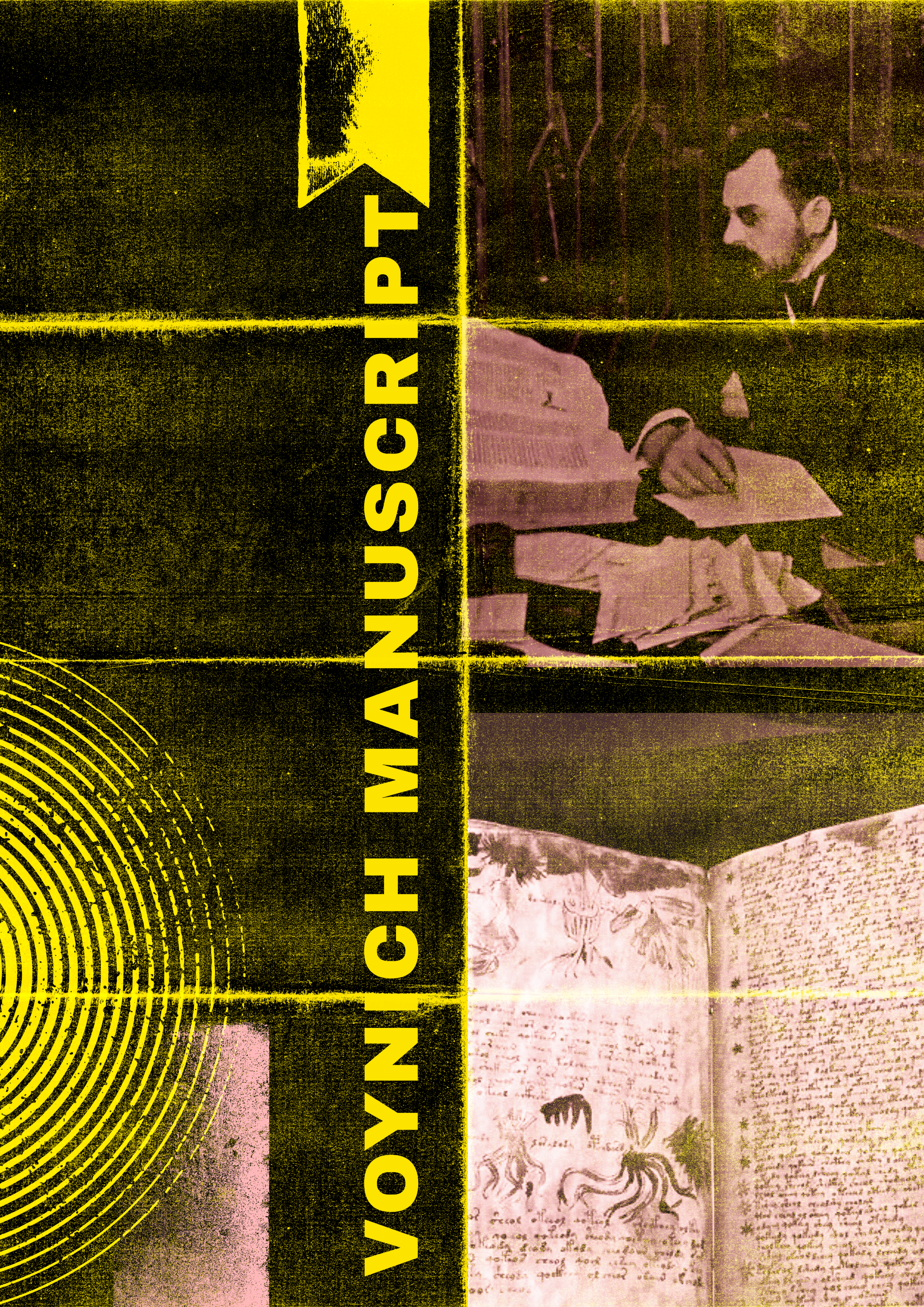
In 1912, rare-book dealer Wilfrid Voynich acquired a plain vellum codex from a Jesuit collection in Italy. At first glance, it looked like a medieval manuscript of medicine, plants, astrology, or natural philosophy.
Then he opened it.
The pages were filled with drawings that refused easy explanation. Plants appeared with unfamiliar roots, leaves, and flowers. Circular diagrams looked like star charts or cosmological maps. Small nude women appeared in green pools and tubs connected by pipes. Foldout pages expanded into elaborate designs. Line after line of unknown writing crossed the parchment from left to right.
The book looked deliberate. It had sections, repeated symbols, spacing, illustrations, and a practiced hand behind the script.
But Voynich could not read it.
More than a century later, the manuscript remains undeciphered.
What Is the Voynich Manuscript?
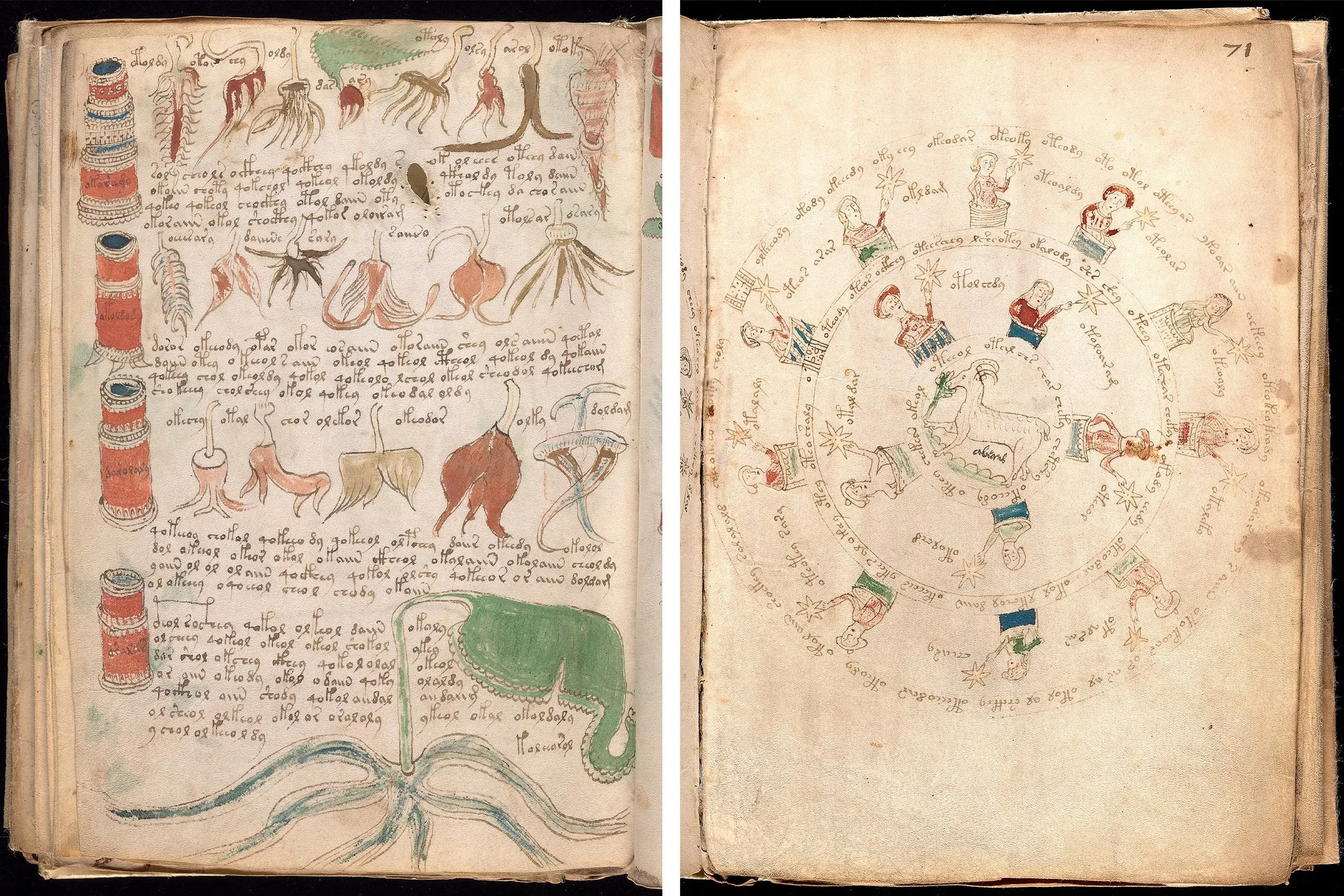
The Voynich Manuscript is a medieval illustrated codex now held by Yale University’s Beinecke Rare Book & Manuscript Library, where it is catalogued as Beinecke MS 408. It has roughly 240 surviving pages, though some are missing. The parchment dates to the early fifteenth century, with radiocarbon testing often placing it between 1404 and 1438.
The manuscript is written in an unknown script often called Voynichese. Its author is unknown. Its language, if it is a language, has not been identified. Its purpose has never been proved.
The codex is usually divided by illustration type: botanical, astronomical or astrological, biological or balneological, cosmological, pharmaceutical, and text-heavy pages often called recipes.
Those labels are useful, but they are modern labels. They describe what the pages appear to show. They do not prove what the book was meant to be.
Wilfrid Voynich and the Italian Purchase
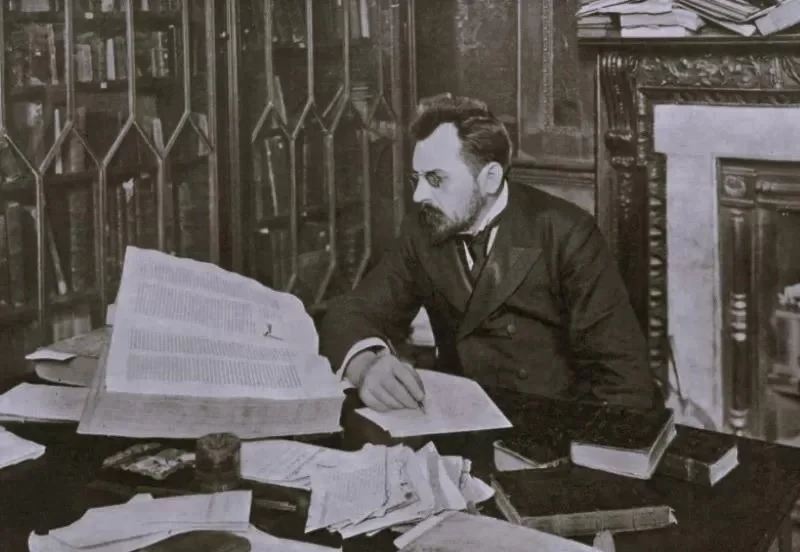
Wilfrid Voynich was born Michał Habdank-Wojnicz in 1865 in the Russian Empire. As a young man, he became involved in anti-tsarist revolutionary circles, was arrested, and was exiled to Siberia. He escaped in 1890 and eventually reached London.
There, he rebuilt his life and entered the rare-book trade. By the early twentieth century, Voynich had become a respected dealer with connections to collectors, libraries, and scholars. He knew old parchment, old bindings, strange provenance, and the value of a manuscript that could turn into a prize.
In 1912, he acquired the manuscript from a Jesuit collection connected to the Villa Mondragone near Frascati, outside Rome. The book had been in Jesuit hands for centuries before Voynich brought it back into circulation.
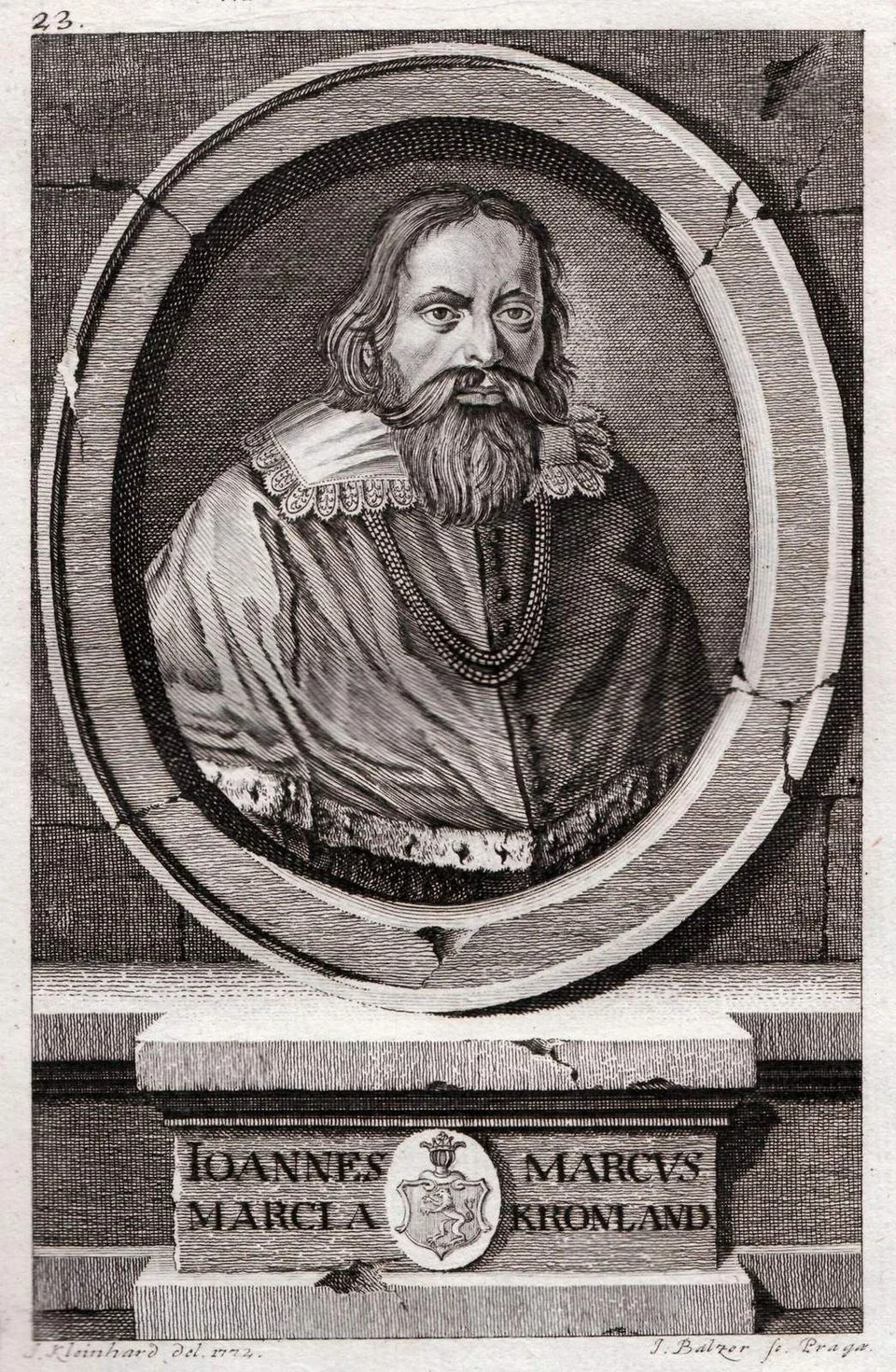
Inside the manuscript was a letter dated 1665 or 1666 from Johannes Marcus Marci of Prague to the Jesuit scholar Athanasius Kircher. Marci wrote that the manuscript had once belonged to Emperor Rudolf II and that Rudolf had supposedly paid 600 ducats for it. He also repeated a tradition that the author might have been Roger Bacon.
For Voynich, that was explosive. Roger Bacon was a thirteenth-century friar associated with natural philosophy, optics, languages, and experimental learning. A mysterious book of plants, stars, medicine, and coded writing would have fit the public image of Bacon perfectly.
The parchment date later pushed that theory out of reach.
What Is Inside the Voynich Manuscript?
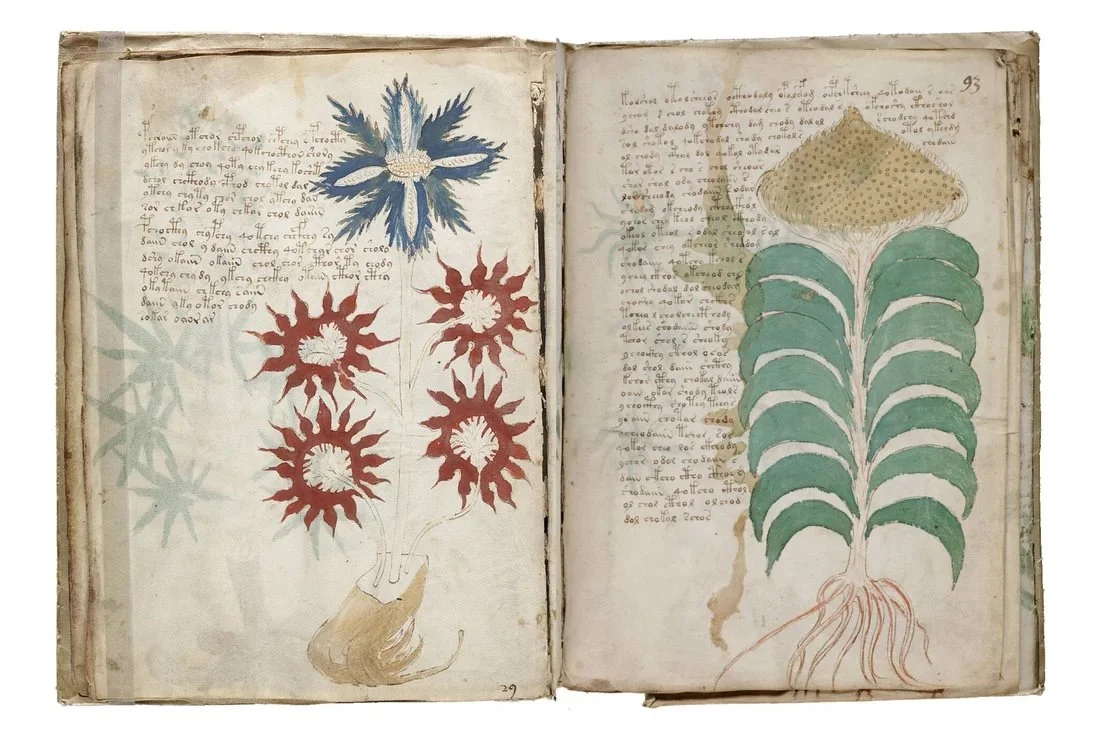
The first large section of the manuscript is botanical. It shows plant drawings with roots, stems, leaves, and flowers, but many of them do not match known medieval herbals. Some look like composites, with parts that seem borrowed from different plants. Others may be stylized, symbolic, imaginary, or copied from sources now lost.
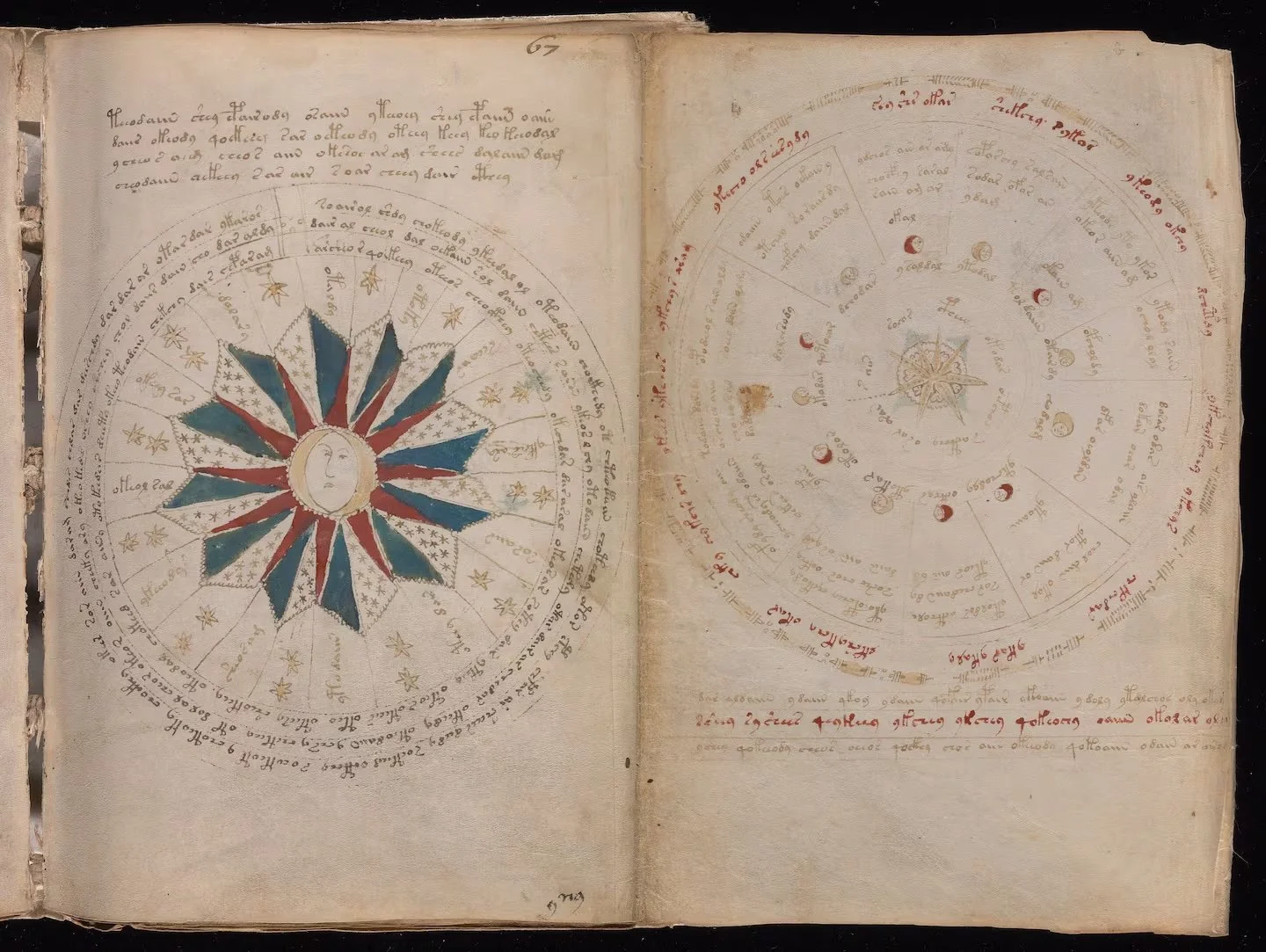
The astronomical and astrological pages include circles, suns, moons, stars, and zodiac imagery. Some pages show female figures arranged around circular designs, as if the body, the heavens, and the calendar all belong to the same system.
The biological or balneological section is stranger. Small nude women appear in green liquid, pools, vessels, and tube-like structures. Some images look medical. Some look cosmological. Some look like diagrams of the body reimagined through water, stars, and channels.
The cosmological section contains foldouts with large circular diagrams. These pages look like maps, heavens, islands, pipes, or imagined structures, depending on who is looking.
The pharmaceutical section shows jars, roots, and plant parts. It resembles the practical world of medieval medicine, where plants, compounds, and preparation mattered.
The final text-heavy section has dense paragraphs with star-like marks in the margins. Researchers often call this the recipe section, although the text has not been translated.
The manuscript looks like a book of knowledge. The trouble is that the knowledge remains locked behind the script.
The Writing
Voynichese runs from left to right in neat lines. The symbols repeat. Word-like units appear with spaces between them. Some signs occur more often at the beginning or end of words. Some words cluster in certain sections. The handwriting looks fluent rather than hesitant.
That fluency has made the manuscript difficult to dismiss.
A few pages of nonsense could be made quickly. More than two hundred pages of structured, section-specific writing is harder to explain. The text has patterns that look language-like, but those patterns do not match any known language well enough to produce a reliable translation.
Cryptographers have tried to read it as a cipher. Linguists have tried to read it as language. Historians have tried to place it inside medieval medicine, astrology, women’s health, alchemy, and herbal traditions. Computer analysis has found structure, repetition, and odd statistical behavior.
The manuscript has resisted all of it.
The Prague Trail
The earliest solid historical trail runs through Prague.
The erased ownership mark of Jacobus Horcicky de Tepenecz appears on the first page under ultraviolet light. Tepenecz served Emperor Rudolf II and worked in the world of medicine and botanical preparations. His name connects the manuscript to the learned and occult interests of Rudolfine Prague.
After Tepenecz, the manuscript passed to Georg Baresch, an alchemist in Prague. Baresch could not read it. He sent samples of the script to Athanasius Kircher, a Jesuit scholar in Rome famous for his work on languages, Egypt, magnetism, and hidden knowledge.
Baresch died before the problem was solved. The manuscript then passed to Johannes Marcus Marci, who sent it to Kircher with the letter that survived inside the book.
After that, the manuscript entered Jesuit collections. It would remain there until Voynich acquired it in 1912.
That trail does not explain who made the book. It does show that educated men in the seventeenth century already could not read it.
Roger Bacon and the Parchment Date
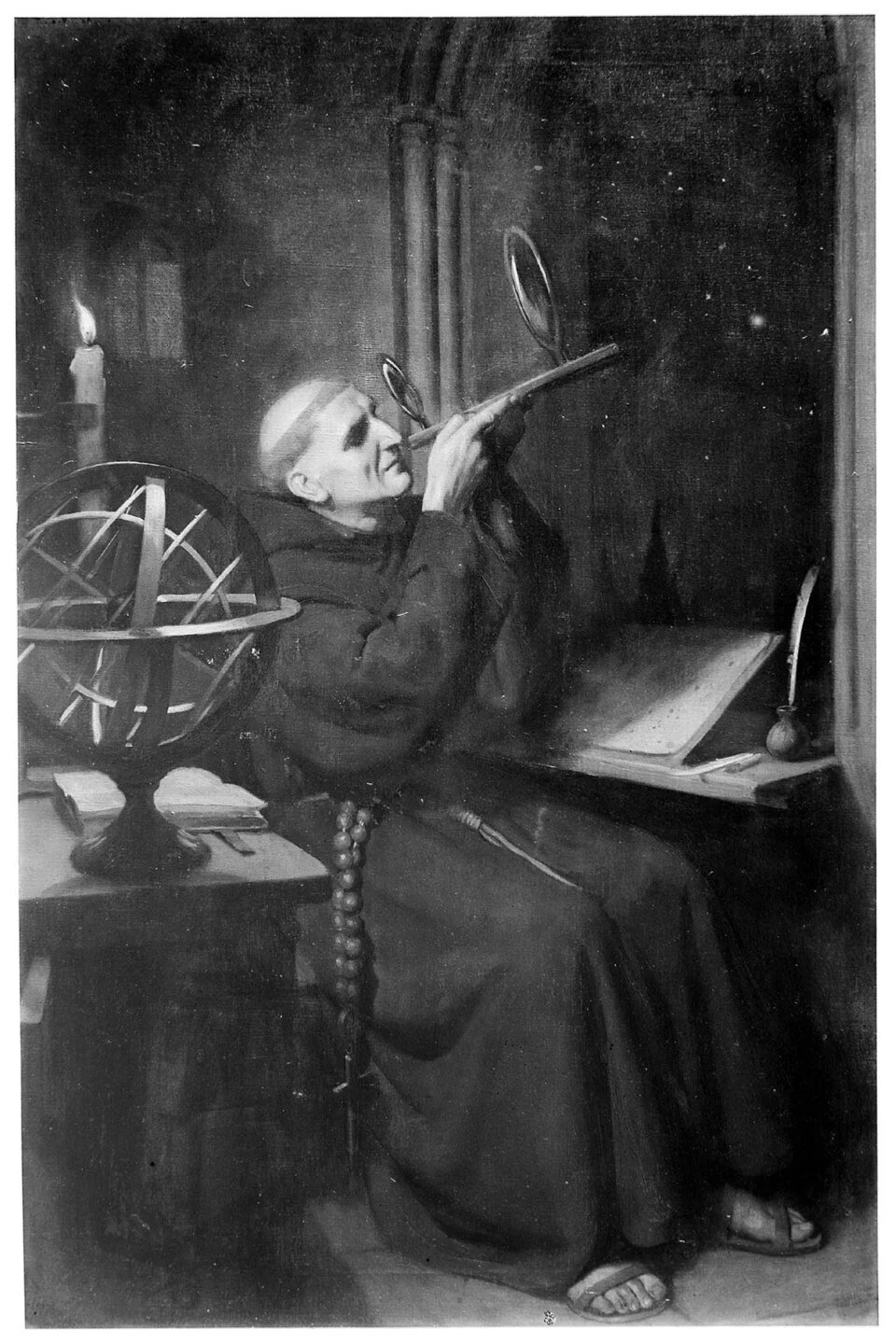
Roger Bacon made an attractive candidate because he belonged to the right kind of legend. He was medieval, learned, experimental, and later associated with hidden knowledge. Voynich promoted the connection after buying the manuscript.
Radiocarbon testing made that theory extremely unlikely.
The parchment dates to the early fifteenth century, usually given as 1404 to 1438. Bacon died in 1292. A manuscript written on fifteenth-century parchment cannot easily be his work.
Someone could have copied an older Bacon text onto later parchment, but that would require evidence from the script, language, illustrations, or provenance. That evidence has not appeared.
The Bacon theory helped make the manuscript famous.
The parchment date moved the manuscript into a different century.
Could It Be a Cipher?
A cipher remains one of the oldest possibilities.
The manuscript may contain a real text hidden behind invented symbols, substitutions, abbreviations, null characters, or a more complex system. That would explain the regular spacing, repeated word forms, and confident writing.
The difficulty is scale. The text is long, and any proposed cipher has to work across the whole manuscript, not only a selected page or phrase. A solution also has to explain why certain word forms appear heavily in one section and rarely in another.
Major cryptographers have worked on the manuscript, including William F. Friedman and others connected to twentieth-century codebreaking. Their work did not produce a solution.
The cipher theory remains possible, but it has never produced a translation that scholars broadly accept.
Could It Be a Real Language?
Some features of the text look like language. Words repeat. The writing has spacing. Different sections appear to have different vocabularies. Lines flow naturally. The script has enough consistency to suggest rules.
That has led to theories involving lost languages, shorthand, artificial languages, phonetic writing, abbreviated Latin, Hebrew, Nahuatl, Romance languages, and other possibilities.
A real-language solution would need to read the manuscript at length. It would need grammar, repeated vocabulary, consistency across pages, and a way to connect the text to the images.
A handful of words cannot solve a book.
So far, every proposed translation has failed to win broad expert support.
Could It Be a Hoax?
The hoax theory has never disappeared.
A meaningless book made to impress a wealthy buyer would explain the unreadable text. Rudolf II’s court, with its appetite for alchemy, astrology, rare books, instruments, and wonders, would have been a tempting market for an elaborate fake.
But the hoax theory has problems.
The manuscript is long. The text changes by section. The writing has internal structure. The illustrations are strange, but not careless. Whoever made it spent a great deal of time creating a book that looked organized, learned, and purposeful.
A hoax is possible.
A lazy hoax is not.
The Plants
The plant drawings should make the manuscript easier to understand. Medieval herbals often use recognizable plants: mandrake, sage, rosemary, poppy, iris, and dozens of others. A known plant can lead to a known medical tradition, and that tradition can help identify expected words.
The Voynich plants refuse that kind of help.
Some look partly familiar. Others look impossible. Roots twist into shapes that seem animal, human, or symbolic. Leaves and flowers do not always belong together. Researchers have proposed European plants, Mediterranean plants, Asian plants, American plants, and imaginary plants.
The illustrations may be stylized. They may copy poor models. They may combine plant parts for medical or symbolic reasons. They may represent a botanical tradition that does not survive elsewhere.
Whatever the answer, the plants have not unlocked the text.
The Women in the Green Pools
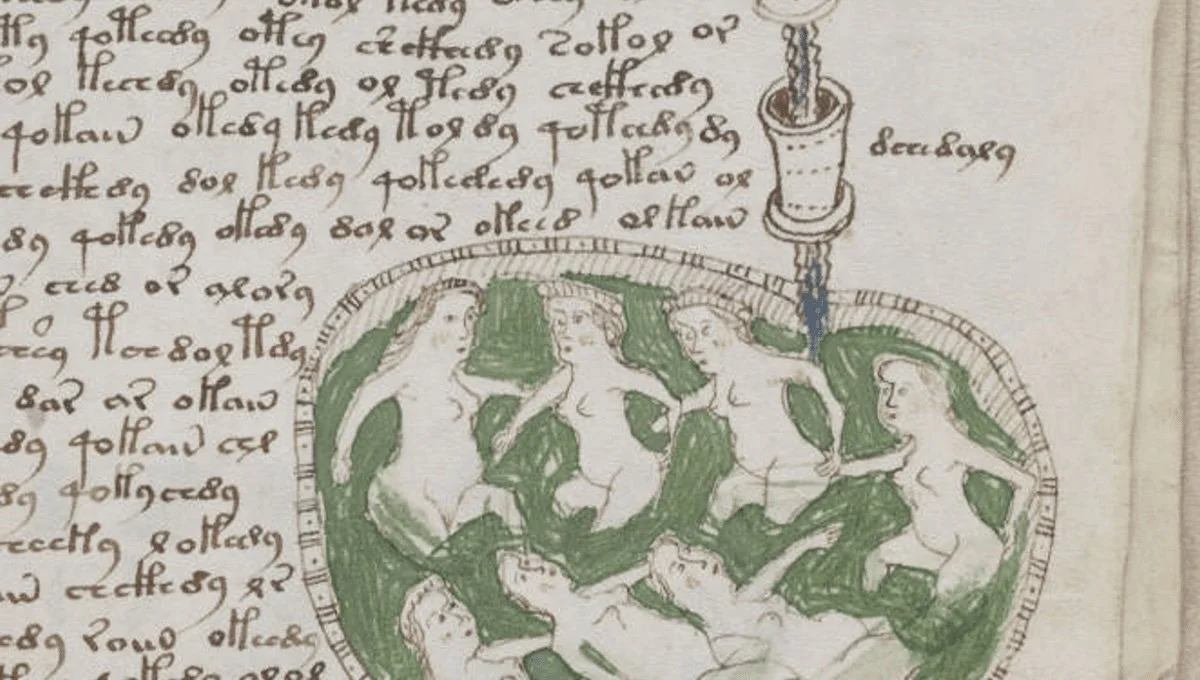
The pages with bathing women are among the most famous in the manuscript.
The figures appear in tubs, pools, and strange connected vessels. Green liquid runs through channels. Some women hold objects. Some appear near star shapes. The pages have been linked to bathing, fertility, women’s medicine, anatomy, astrology, humors, digestion, and cosmology.
Medieval medicine often connected the body to the stars, seasons, elements, and fluids. A manuscript that combined plants, astrology, baths, and remedies would not be out of place in that world.
But the Voynich images do not match an obvious medical handbook. The pipes and pools remain strange even by medieval standards.
The women may represent patients, nymphs, stars, organs, souls, fluids, or something else entirely.
The text beside them has not yielded an answer.
The Manuscript Today
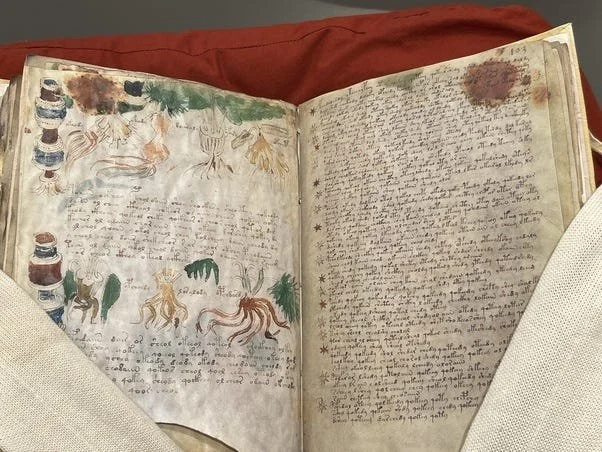
The Voynich Manuscript now lives at Yale, digitized and available for anyone to view online. That access has made it even more famous. Scholars, cryptographers, medievalists, computer scientists, botanists, artists, and amateur codebreakers can study the same pages without traveling to the Beinecke Library.
The digital images have also created a modern wave of claims. Some people announce translations. Some identify plants. Some find maps, prayers, recipes, women’s health texts, alchemical systems, or lost languages.
The manuscript survives those claims because the same basic problem remains: a proposed solution has to read more than a few chosen lines. It has to work across the book.
The Voynich Manuscript has not offered that kind of solution.
The Medieval Book Nobody Can Read
The Voynich Manuscript is a real medieval object, not a modern internet mystery. Its parchment dates to the early fifteenth century. Its ownership trail reaches at least as far back as early modern Prague. Its pages carry plants, stars, women, jars, diagrams, and hundreds of lines of unknown writing.
It may be a cipher. It may be a lost or artificial language. It may be a private shorthand. It may be an elaborate medieval fraud. It may be something scholars have not yet described with the right tools.
For now, the manuscript remains what it has been for centuries: a book full of writing, passed from hand to hand, studied by people who believed the answer was close.
The pages are open.
The words remain unread.
Want More?
You can listen to a full deep dive of this topic on the Time and Tales Podcast, now!
Also…
If you’re drawn to dark history, old folklore, lost places, and unsolved mysteries, my books might be just what you’re looking for!
Start with A Vow for Breaking for Appalachian folk horror, family curses, and a house full of secrets — or A Dark Most Fair for a dark fairy tale about jealousy, longing, and a dangerous bargain with the fey.
Sources
Beinecke Rare Book & Manuscript Library. “Beinecke MS 408.” Yale University Library.
Beinecke Rare Book & Manuscript Library. “Voynich Manuscript.” Yale University Library.
D’Imperio, M. E. The Voynich Manuscript: An Elegant Enigma. National Security Agency/Central Security Service, 1978.
Kennedy, Gerry, and Rob Churchill. The Voynich Manuscript: The Mysterious Code That Has Defied Interpretation for Centuries. Orion, 2004.
Phys.org. “Experts Determine Age of Book ‘Nobody Can Read.’” Phys.org, 10 Feb. 2011.
Schinner, Andreas. “The Voynich Manuscript: Evidence of the Hoax Hypothesis.” Cryptologia, vol. 31, no. 2, 2007, pp. 95–107.
Tiltman, John H. “The Voynich Manuscript: The Most Mysterious Manuscript in the World.” NSA Technical Journal, 1967.
Zandbergen, René. “The Radio-Carbon Dating of the Voynich MS.” Voynich.nu.