Boudicca and the Ash Road
In 60 or 61 CE, Londinium burned.
Archaeologists would later find the destruction beneath modern London: a red-black layer of burned clay, charcoal, scorched timber, warped tile, and ash. Londinium wasn’t the only Roman settlement destroyed. Days earlier, Camulodunum had fallen. Soon after Londinium, Verulamium burned too.
At the center of the revolt was Boudicca, queen of the Iceni, a woman Rome humiliated in public and then badly underestimated.
The uprising became one of the most devastating revolts in Roman Britain. Three major settlements were destroyed. Thousands died. Rome came close to losing control of the province. The fire left a mark deep enough for modern archaeologists to trace through the soil.
Who Was Boudicca?
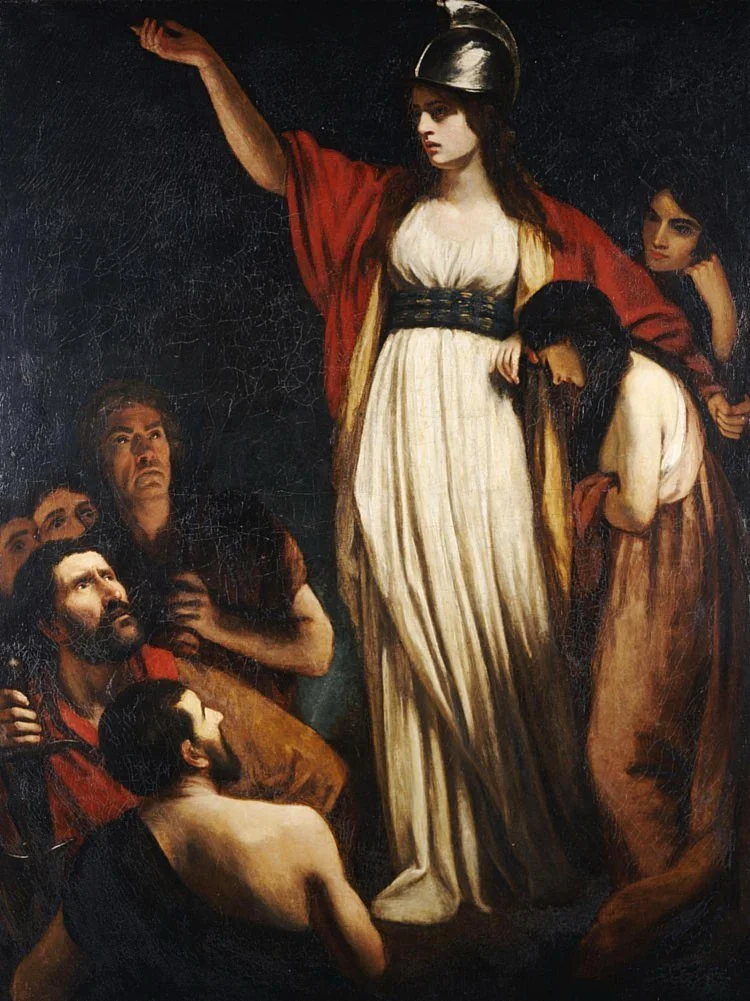
Boudicca was queen of the Iceni, a people based in what is now eastern England, especially the region around modern Norfolk. Roman writers describe her as tall and commanding, with long reddish hair and a fierce voice. Those descriptions come from Roman authors writing after the revolt, so they carry the usual Roman taste for drama, but even through hostile sources, Boudicca comes across as a leader with real authority.
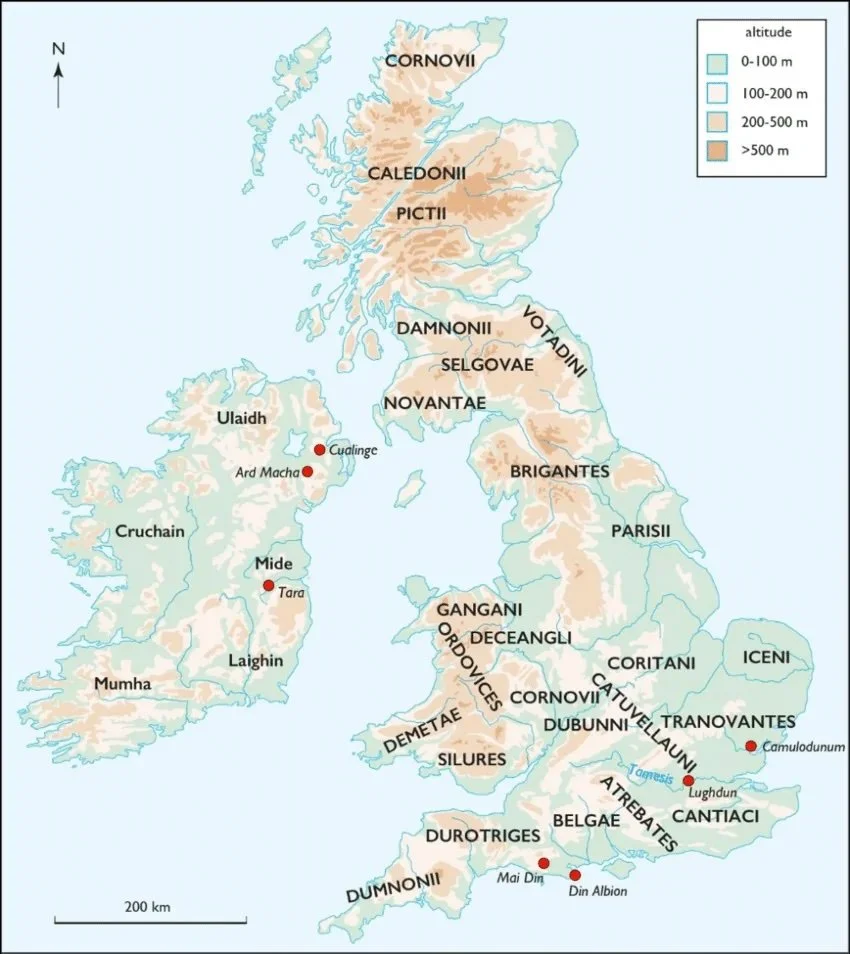
Before the revolt, the Iceni had operated as a client kingdom under Rome. They had a local ruler, Prasutagus, who held power while acknowledging Roman authority. Client kingship was a fragile compromise. Rome gained stability without constant military pressure, and the Iceni retained some control over their own affairs.
That arrangement depended on Rome respecting the local dynasty. When Prasutagus died, Rome did the opposite.
Rome Takes the Iceni Kingdom
Prasutagus tried to protect his family through his will. According to Tacitus, he named both the Roman emperor and his two daughters as heirs. He may have believed this would preserve peace: Rome would receive a share of his wealth, while his daughters would inherit enough to continue the Iceni royal line.
Roman officials treated the kingdom as annexed property instead. Iceni nobles lost lands. Prasutagus’s household was stripped of wealth. Loans were called in. Property was seized. Boudicca protested, and Rome answered with public violence.
Boudicca was flogged. Her daughters were sexually assaulted. This was not only an attack on one family. It was an attack on the Iceni royal line, staged in front of the people Rome expected to control.
The Iceni had paid taxes. They had accepted Roman authority. They had lived within the client-kingdom arrangement Rome had allowed them. Then Rome showed them what that arrangement was worth.
Roman Britain Before the Revolt
Rome had been pushing into Britain for generations. Julius Caesar crossed into Britain in 55 and 54 BCE, but he did not create a permanent province. The major conquest came under Emperor Claudius in 43 CE.
After that, Roman power spread through southern Britain through warfare, roads, forts, taxation, veteran colonies, and political pressure. Some local elites benefited. Rome could offer trade, legal status, imported goods, military protection, urban life, and access to the wider imperial world.
Those benefits came with occupation. Land could be seized. Taxes could crush communities. Local rulers could be replaced. Veterans could receive farms taken from native people. Temples to dead emperors could rise in places where the conquered population paid for the stone.
For many Britons, Roman rule meant a foreign power had taken control of land, law, labor, and wealth. Boudicca’s family became the breaking point.
The Roman Army Was Far Away
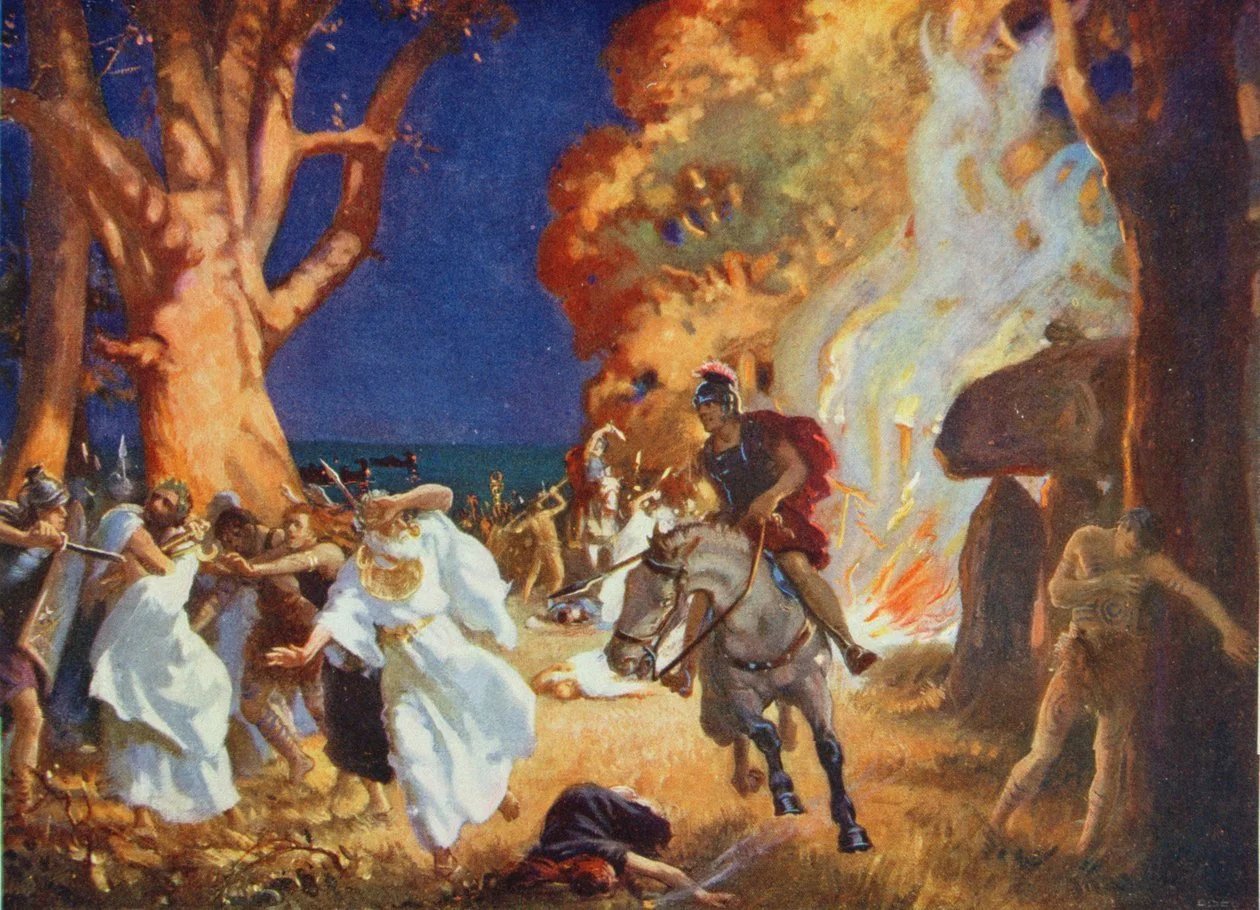
When the Iceni revolt began, the main Roman army was not in the east. The governor of Britain, Gaius Suetonius Paulinus, had marched west to attack Mona, modern Anglesey.
Mona was associated with the Druids, who held religious, legal, and intellectual authority among many Brittonic peoples. To Rome, the Druids were more than priests. They were advisors, judges, teachers, and symbols of resistance. Roman control of Britain would always be limited while Mona remained a religious center outside its reach.
Tacitus describes the attack on Mona in dramatic terms: armed Britons on the shore, women in black carrying torches, Druids raising their hands and calling down curses, and Roman soldiers pausing before they advanced.
The Romans crossed, attacked, killed defenders, destroyed sacred groves, and burned altars. While Suetonius was in the west, the east erupted.
Boudicca Builds a Revolt
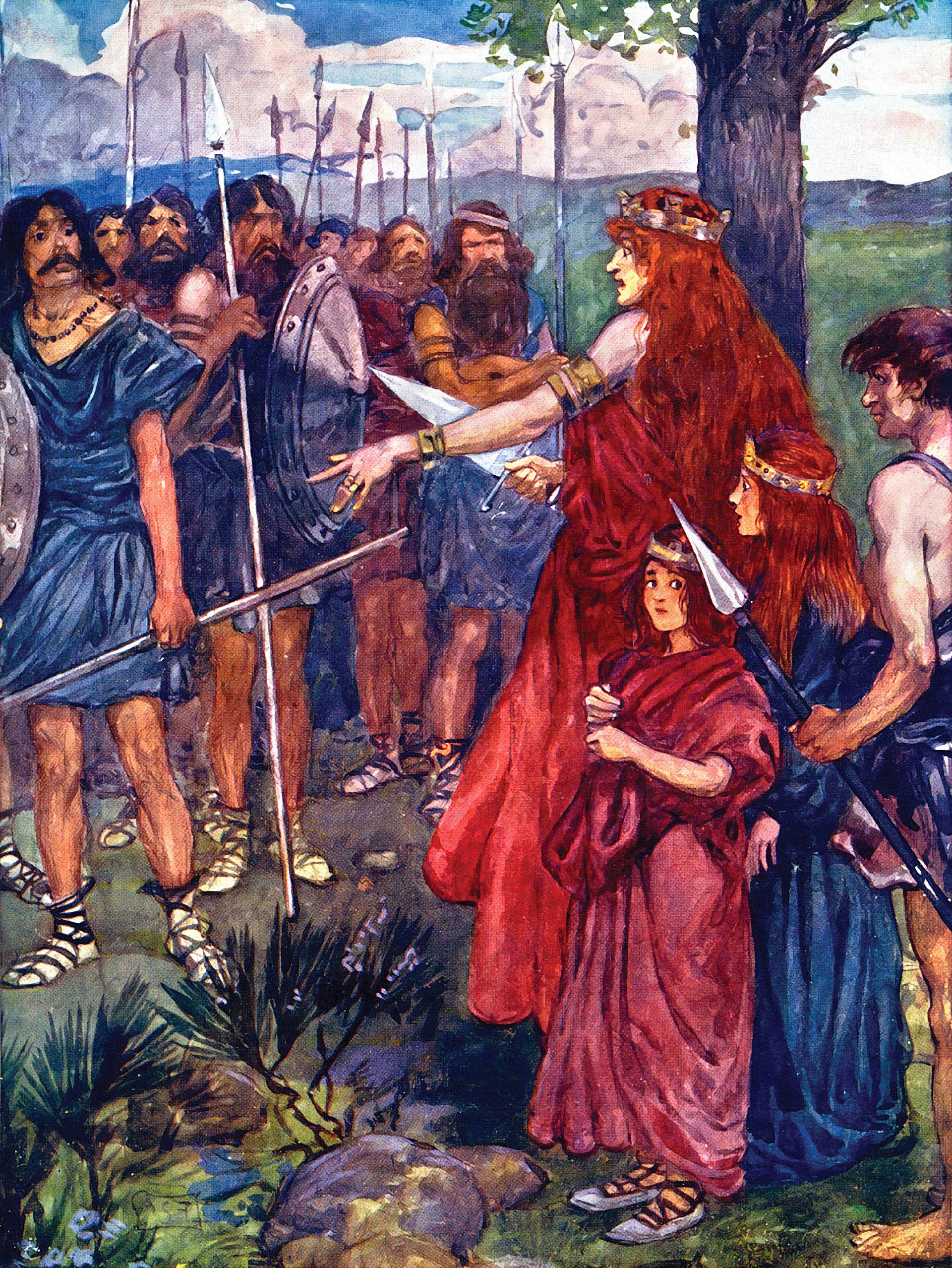
The Iceni were not alone for long. The Trinovantes joined Boudicca first. They had their own reasons to hate Rome. Their former lands had been taken for the Roman veteran colony at Camulodunum, modern Colchester.
Other groups joined or supported the revolt as well. Roman sources do not give us a neat tribal roster, but the rebellion clearly spread beyond the Iceni. Boudicca drew support from people already angry over land seizures, taxation, abuse by officials, veteran settlements, and fear of direct annexation.
The revolt moved first toward Camulodunum, Rome’s first major colony in Britain. It housed retired Roman soldiers and symbolized the conquest under Claudius. At its center rose the Temple of the Deified Claudius, built through heavy taxation and dedicated to the emperor who had conquered Britain.
To Roman settlers, Camulodunum represented victory. To many Britons, it represented occupation carved in stone.
Camulodunum Burns
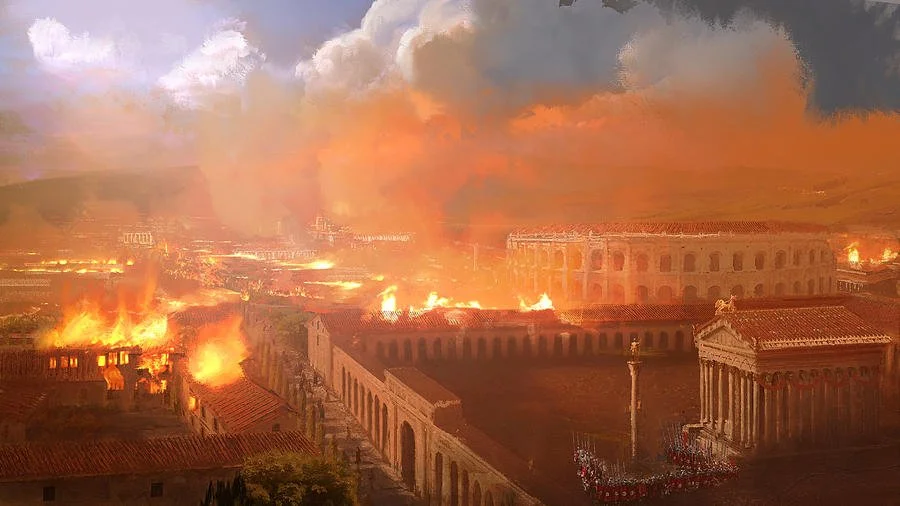
Camulodunum had symbolic power, but weak defenses. The people inside appealed for help. The procurator Catus Decianus sent a small force, then fled the province. A detachment of the Ninth Legion marched to relieve the colony, but Boudicca’s army intercepted it.
The Roman infantry were destroyed. The cavalry escaped. Inside Camulodunum, defenders withdrew into the Temple of Claudius. They lasted two days before the rebels broke through.
The settlement burned.
Archaeology still carries the destruction: burned daub, scorched floors, warped tile, damaged glass, smashed household goods, and debris from buildings destroyed in the revolt. After Camulodunum fell, Boudicca’s army turned south.
Londinium Burns
Londinium was young, wealthy, and strategically placed. It had grown around trade and the Thames crossing, but in 60 or 61 CE, it was not yet the stone-walled capital people imagine when they hear “Roman London.”
It had merchants, warehouses, money, goods, and roads. It did not have the defenses to survive Boudicca’s army.
Suetonius rushed back from the west. When he reached Londinium, he had to choose between defending the settlement and preserving the army. He chose the army.
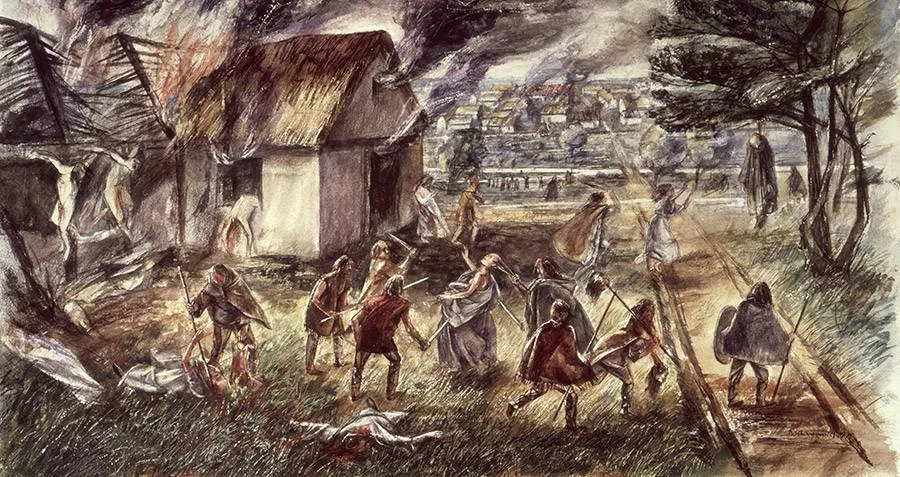
The governor ordered an evacuation. Officials, merchants, families, and anyone with transport fled. The elderly, the sick, the stubborn, and those without a way out remained behind as the Roman column left.
Boudicca’s forces entered Londinium and burned it. Archaeologists in central London have found thick layers of burned debris from the attack, including pottery and personal possessions from buildings destroyed during the revolt.
Verulamium Burns
After Londinium, Boudicca’s army moved toward Verulamium, the Roman town that later became St. Albans. The settlement lay along an important road northwest of Londinium and had grown wealthy under Roman influence.
Like Londinium, Verulamium did not have the kind of defenses that could withstand a large rebel force already carrying the momentum of two major victories. The town burned in the same season as Camulodunum and Londinium. Archaeological evidence from the site includes burn layers and destruction debris tied to the revolt, though the evidence differs from the thicker destruction layers found in London and Colchester.
By the time the rebels finished at Verulamium, three major Roman-aligned settlements had been destroyed. Tacitus gives the number of Roman and allied dead as around 70,000. Later tellings often use 80,000. Ancient casualty numbers are notoriously difficult, and Roman writers often inflated totals, especially when describing enemies and disasters. Even with that caution, the destruction across Camulodunum, Londinium, and Verulamium was enormous.
Rome had lost settlements, civilians, veterans, trade centers, supplies, and the appearance of control in the province. Suetonius Paulinus needed a decisive battle before the revolt spread further.
The Final Battle
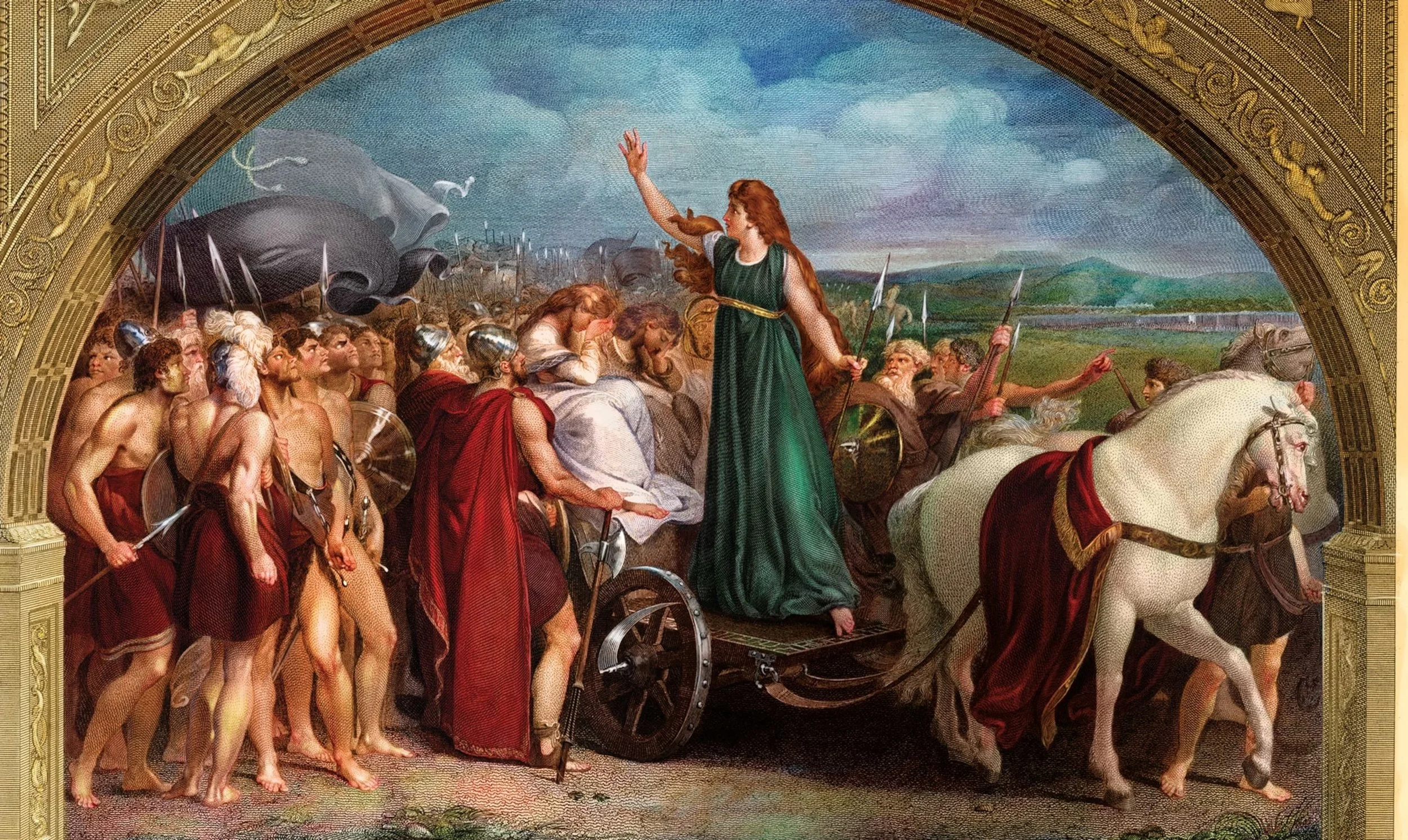
Suetonius gathered the forces he could reach in time. His army included detachments from the Fourteenth Legion, the Twentieth Legion, and available auxiliaries. The Second Legion did not arrive. Tacitus later treated that failure as disgraceful, and its commander reportedly took his own life after the Roman victory.
Boudicca’s army was much larger, though the exact size is impossible to know. Roman writers describe a massive tribal force, along with wagons, families, and supplies following behind. That detail matters because Boudicca’s people appear to have expected not only a battle, but a final victory over Roman power in Britain.
Suetonius chose his ground carefully. The battle happened somewhere along a Roman road, often linked in later tradition to Watling Street, though the exact location has never been confirmed. Tacitus describes a narrow battlefield with woodland behind the Roman line and open ground in front. The terrain favored a smaller, disciplined army. It limited the space available to Boudicca’s larger force and protected the Roman rear from being surrounded.
When the Britons advanced, the Romans waited until they came within range. Then the legionaries threw their pila, heavy javelins designed to punch through shields and break the force of an attack. After the first volley, the Roman infantry advanced in tight formation with shields forward and short swords ready.
This was where Roman training mattered. In open ground, Boudicca’s numbers and chariots could have been devastating. In the narrow approach Suetonius had chosen, the Britons could not spread out around the Roman line. Their own wagons blocked the space behind them. When the front ranks broke and tried to retreat, they ran back into the carts, animals, families, and followers who had come behind the army.
The battle turned into a massacre. Tacitus gives Roman losses as very low and British losses as catastrophic. The exact numbers are not reliable, but the result is clear: Boudicca’s revolt was crushed in a single battle.
What Happened to Boudicca?
Boudicca disappears after the defeat. Tacitus says she poisoned herself. Cassius Dio says she fell ill and died. Neither account names a burial place, and no confirmed grave has ever been found.
Later legends have tried to place her burial in several locations, including London and other parts of Britain, but those claims do not rest on firm evidence. The only secure point is that she did not appear again after the final battle.
Rome punished the rebels after the victory. Farms were abandoned, food production suffered, and the province absorbed the revolt through military repression and administrative change. Suetonius Paulinus had won the battle, but his severity made Britain harder to govern. Rome eventually replaced him with a less aggressive governor.
Boudicca failed to drive Rome from Britain. She did, however, expose how fragile Roman control could be when local rulers, dispossessed tribes, and abused client kingdoms moved together.
Boudicca and the Ash Road
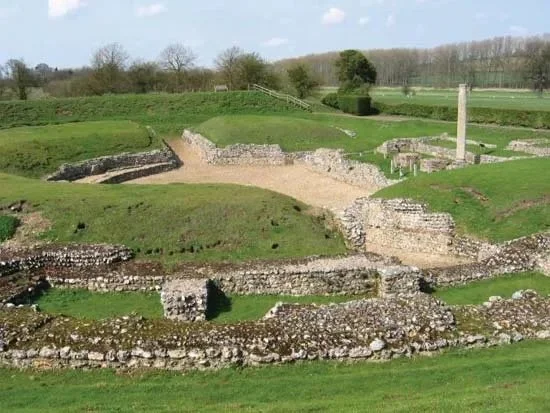
Modern archaeology still preserves the violence of the revolt. London has its Boudiccan destruction layer. Colchester has burned debris tied to the attack on Camulodunum. Verulamium has burn evidence from the same period.
The ash layer gives the revolt a physical shape. Beneath modern streets, offices, rails, and stone, there is still evidence of the season when Boudicca’s army burned through Roman Britain.
Boudicca was a queen whose family was brutalized by Rome. She united tribes under one cause, destroyed three Roman settlements, and brought the province close to collapse. Rome defeated her army on a road no one can identify with certainty.
The ash remains.
Want more?
You can listen to a full deep dive of this topic on the Time and Tales Podcast, now!
Also…
If you’re drawn to dark history, old folklore, lost places, and unsolved mysteries, my books might be just what you’re looking for!
Start with A Vow for Breaking for Appalachian folk horror, family curses, and a house full of secrets — or A Dark Most Fair for a dark fairy tale about jealousy, longing, and a dangerous bargain with the fey.
Sources
Aldhouse-Green, Miranda. Boudica Britannia: Rebel, War-Leader and Queen. Routledge, 2021.
Cassius Dio. Roman History. Translated by Earnest Cary, Loeb Classical Library, Harvard University Press, 1914–1927.
Colchester Archaeological Trust. “The Trust Excavates Boudican Destruction Debris at Williams & Griffin Site.” Colchester Archaeological Trust, 14 May 2014.
Hingley, Richard, and Christina Unwin. Boudica: Iron Age Warrior Queen. Hambledon Continuum, 2004.
London Museum. “Boudica: Rebel Queen of the Iceni.” London Museum.
Millett, Martin. The Romanization of Britain: An Essay in Archaeological Interpretation. Cambridge University Press, 1990.
Tacitus. The Annals. Translated by J. C. Yardley, Oxford University Press, 2008.
Tacitus. Agricola. Translated by A. R. Birley, Oxford University Press, 2009.
University of Warwick Classics Network. “Boudica’s Revolt AD 60–61.” University of Warwick, 25 Sept. 2020.